children’s plastic watch
The God of Small ThingsThe children’s plastic watch is a small, forgotten object whose painted time—ten to two—remains fixed while the years pass around it. Buried beneath grass and twenty-three years of June rain, it gives physical form to the story’s insistence that history’s violence persists in ordinary things, even when the terror itself has receded from view.
Appearance and Discovery
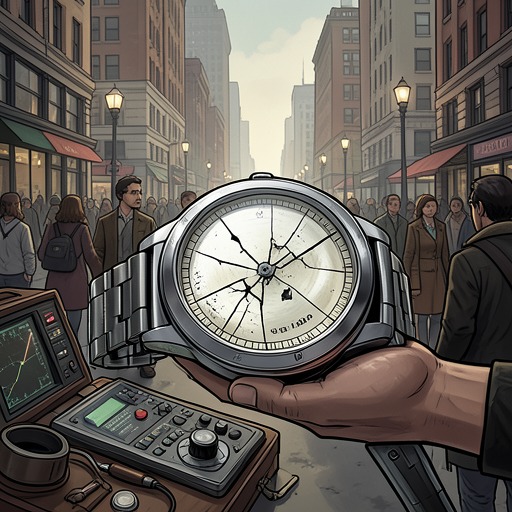
The watch is described as a child’s plastic wristwatch with the time painted on it. Its face does not record changing minutes: it preserves a single, manufactured indication of time. The object lies under grass, covered by twenty-three years of June rain, and is called both small and forgotten. The world, the narration observes, would not miss it. Its modest scale and neglect make its survival all the more telling: what appears disposable can outlast the attention paid to it.
The watch belongs to a sequence of overlooked remnants, among them a cartful of defective toothbrushes at the Cochin Harbor Terminus. Set beside objects that are damaged, cheap, or abandoned, it is not presented as a treasured keepsake. Its force comes instead from the mismatch between its apparent insignificance and what its fixed time recalls.
Time and the Buried Past
The watch’s painted ten to two becomes legible against the passage of twenty-three years. The date-like precision of the frozen time contrasts with the long, weathered duration of its burial: rain accumulates, grass grows over it, and the remembered catastrophe recedes into the past, but the object remains. It does not explain what happened; it offers a concrete point at which the reader can feel the distance between the event and its later aftermath.
That contrast echoes the novel’s account of history as something that leaves traces in ordinary things. The twins learn that history sets terms and exacts payment from those who break its laws; they hear its thud and smell it, and do not forget. The watch makes that persistence material. Its stillness is not a clock’s reliable measurement of time but the survival of a small thing that has been left behind by it.
Memory and Narrative Significance
The watch’s buried presence links private memory to the wider landscape of loss. It is neither a public monument nor an object the world recognizes as important. Yet its specific, frozen time gives shape to what ordinary speech and public attention may leave unacknowledged: the past remains lodged in the present, beneath the surface of daily life.
The novel also places the watch within a pattern of objects through which history returns. History’s smell is said to linger in coat hangers, tomatoes, road tar, colors, restaurant plates, and even the absence of words or the emptiness in eyes. Against that catalogue, the watch is a particularly concentrated remnant: a child’s toy, buried and overlooked, whose painted time makes the past visible without resolving it. Its significance lies in the tension between how little it seems to matter and how much its survival asks the reader to remember.